Jetter Nozzle Showdown:
Professionals need the right tools to clear severe mainline blockages efficiently. Hydro jetting requires premium equipment to slice through roots and grease accumulations. Plumbers often debate the choice between the Warthog nozzle and the Reaper nozzle. Both tools deliver excellent performance during a hydro jetting drain cleaning service. However, each jetter nozzle utilizes a completely unique design philosophy. This article details the crucial mechanical differences between these industry leading jetting nozzles.
The Reaper Nozzle: Rapid Fire Cutting Edge
The Reaper hydro jetting nozzle uses a completely different physical strategy. It features a heavy-duty stainless steel housing with a fast, free-spinning rotor. The front stream rotates at a precise 24-degree or 30-degree cone angle. This rapid movement creates a wall of high-impact water that acts like a mechanical saw. Moreover, it excels at blasting through immediate blockages quickly.
Primary Benefits of the Reaper:
-
The optimized spray angle delivers superior straight-line cutting power.
-
The Reaper sewer jet nozzle clears blockages using significantly less water.
-
Heavy-duty tungsten carbide wear surfaces outlast cheap ceramic nozzle alternatives.
-
Rear static jets sit at 20 degrees to provide incredible forward thrust.
-
The design allows operators to complete a hydro jetting sewer job much faster.
Key Structural and Operational Differences

Understanding how each tool operates helps you choose the best sewer jetting nozzle for your machine. Please note that you must match the hydro jetter nozzle to your specific pump specifications.
-
Rotational Speed and Mechanics
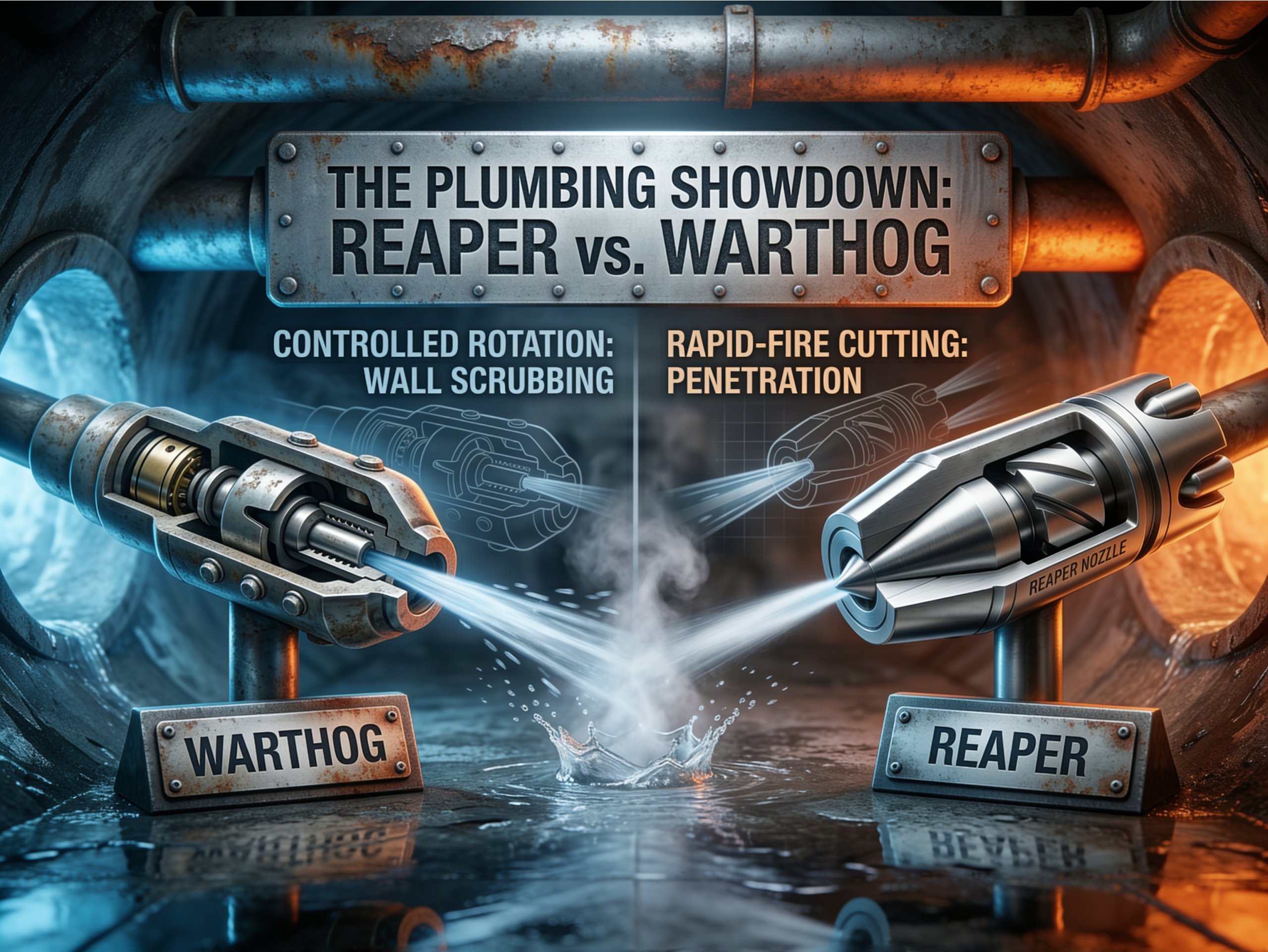
The Warthog sewer jet nozzle focuses on controlled, deliberate rotational motion. The slow speed helps the Warthog drain nozzle scrub pipes completely clean. The Reaper sewer jetter nozzle spins freely at higher speeds to chop up roots.
-
Jet Configurations and Angles
Standard Warthog nozzles feature side descaling jets and an off-center front boring jet. The Reaper uses four sharp rear jets to propel the tool down long lines. Its front jet forms a tight cone to punch holes through solid blockages.
-
Maintenance Requirements
The Warthog requires regular service with viscous fluid every 40 to 50 hours. The Reaper features a simpler design without complex internal fluid chambers. For that reason, you can rebuild a Reaper in the field in roughly ten minutes.
Jetter Nozzle Application Guide: When to Use Each Tool

Choosing the best hydro jetting nozzle depends entirely on the type of clog you face. Different scenarios require specific hydro jetting heads to avoid pipe damage.
When to Choose the Warthog:
Use it when you need to descale thick grease from restaurant lines.
Select this tool for comprehensive 360-degree cleaning of hydro jetting drain pipes.
It works best for clearing heavy, fibrous root intrusions over long sections.
Use it to remove hard ice blockages in cold climates.
When to Choose the Reaper:
-
Use it to punch through sudden, hard blockages in a hydro jetting sewer line.
-
Select this tool when you need maximum pulling power down long pipes.
-
It works perfectly for low-flow jetters that require efficient water conservation.
-
Choose it for rapid root cutting in standard residential lines.
Best Practices and Safety Tips

Operators must learn how to use jet nozzle equipment safely to protect older infrastructure. Always inspect the line with a sewer camera before starting any hydro jetting work.
Follow these hydro jetting tips to achieve the best results in the field:
-
Always idle down your jetter before introducing the nozzle into the pipe.
-
Start with a standard sewer jetting nozzle kit before upgrading to specialized heads.
-
Monitor your system pressure closely to avoid exceeding your hose ratings.
-
Guide the hose slowly to let the water jetting nozzles do the cutting work.
-
Read verified jet nozzle reviews to match equipment with your pump volume and specs.
Jetter Nozzle Frequently Asked Questions

-
Can hydro jetting damage pipes during operation?
Hydro jetting can damage pipes if operators use incorrect pressure or ignore existing structural flaws. Brittle orangeburg, corroded cast iron, and broken clay pipes face the highest risk of failure. Professionals must always perform a sewer camera inspection before clearing the line to evaluate pipe integrity. Furthermore, matching your nozzle and pump pressure to the pipe condition ensures a completely safe cleaning.
-
Does the Reaper or Warthog have better jet nozzle reviews?
Verified industry reviews give both tools exceptional marks, but they praise them for entirely different reasons. Plumbers consistently rate the Warthog as the best overall descaling nozzle because its controlled fluid-braking system scrubs pipe walls completely clean. Conversely, reviews rank the Reaper higher for rapid front-end cutting speed and effortless field maintenance. Therefore, choosing the winner depends on whether your job requires the Warthog’s thorough 360-degree wall scouring or the Reaper’s fast root-chopping power.
-
Which is easier to maintain, the Reaper or the Warthog?
The Reaper features a simpler design without complex internal fluid chambers. Operators can easily rebuild a Reaper in the field in roughly ten minutes. Conversely, the Warthog requires regular maintenance, including refilling its viscous governor fluid every 40 to 50 hours.
-
Does the Reaper or Warthog conserve more water during jetting?
The Reaper clears severe sewer blockages using significantly less water than standard rotating models. In addition, its optimized 24-degree or 30-degree front spray cone focuses maximum impact exactly where needed. Moreover, this efficient engineering makes the Reaper ideal for low-flow jetters operating on restricted water supplies.
-
Can you use the Warthog and Reaper on the same jetter hose?
Yes, you can run both premium jetter nozzles on the same hose if they feature matching inlet thread sizes. Both manufacturers offer standard 1/4-inch, 3/8-inch, and 1/2-inch configurations. However, operators must calibrate their pump GPM and PSI output specifically to each nozzle for safe operation.
-
How much is a jet nozzle?
Premium rotating sewer jetter nozzles generally cost between $550 and $2,400 depending on the thread size. Small 1/4-inch versions of the Warthog and Reaper typically start right around $550 to $585. Heavy-duty 1/2-inch main line cutting nozzles range from $1,000 to over $1,590 based on pump specifications.
The Final Verdict: Warthog or Reaper?

Choosing between the Reaper and Warthog depends on your specific pipe cleaning goals. The Warthog delivers unmatched 360-degree wall scrubbing for total line restoration. Meanwhile, the Reaper utilizes an optimized low-water design to maximize cutting impact on restricted water supplies. Ultimately, your choice depends on whether your immediate priority is high-speed blockage penetration or total pipe wall restoration. At F&A Plumbing, we use the Reaper more often due to its ability to handle most of our jetting needs.
In our opinion, both options deserve a permanent spot in a professional jet nozzle sewer cleaning setup. The Warthog offers unmatched scrubbing capability for absolute line restoration. The Reaper provides devastating front-end cutting speed to clear major blockages fast. Investing in high-quality best sewer jetting nozzles elevates your service quality. Choose the right tool for the job and keep those lines flowing perfectly!
Warthog vs. Reaper: Watch These Jetter Nozzles Go Head-to-Head
Want to see these two powerhouse nozzles go head-to-head? Watch our brutal destruction test as we blast both tools through solid 2×6 Redwood. This real-world demonstration reveals exactly how each nozzle cuts through dense, root-like obstructions. Click the video below to see the ultimate winner of this high-pressure showdown!
Hydro Jetting Services
Contact F&A Plumbing & Rooter TODAY for all of your plumbing needs in Pacifica and the surrounding areas. We offer expert hydro jetting for home and commercial property!
Learn More About F&A Plumbing
Visit Our Homepage To Get Started
Check Out Our Blog
Follow Us On Instagram